Stake Keno gives you a 40-number board, ten numbers drawn per round and four payout settings. You can pick anywhere from one to ten numbers. The rules are short; the useful part is understanding what each result actually pays.
Stake advertises a 99% RTP and payouts up to 1,000×. Neither figure tells you how often your chosen ticket will return money. That depends on how many numbers you pick and which payout table you use.
This review combines interface screenshots, Stake's published rules and calculated probabilities.
Stake.com is unavailable in United States. Wrong location? Change location.
Stake.com is unavailable in United States.
Detected country: United StatesChange location
Stake Keno at a glance
| Feature | Stake Originals Keno |
|---|---|
| Board | 40 numbers |
| Player selection | 1–10 numbers |
| Draw | 10 distinct numbers |
| Payout settings | Classic, Low, Medium and High |
| Advertised RTP | 99% |
| Advertised house edge | 1% |
| Maximum advertised multiplier | 1,000×, depending on the ticket and setting |
| Result verification | Provably Fair |
This article covers Stake Originals Keno on Stake.com. Other Keno games, including games on different platforms, can have different rules and payout tables.
Stake.com is unavailable in United States. Wrong location? Change location.
How to play Stake Keno
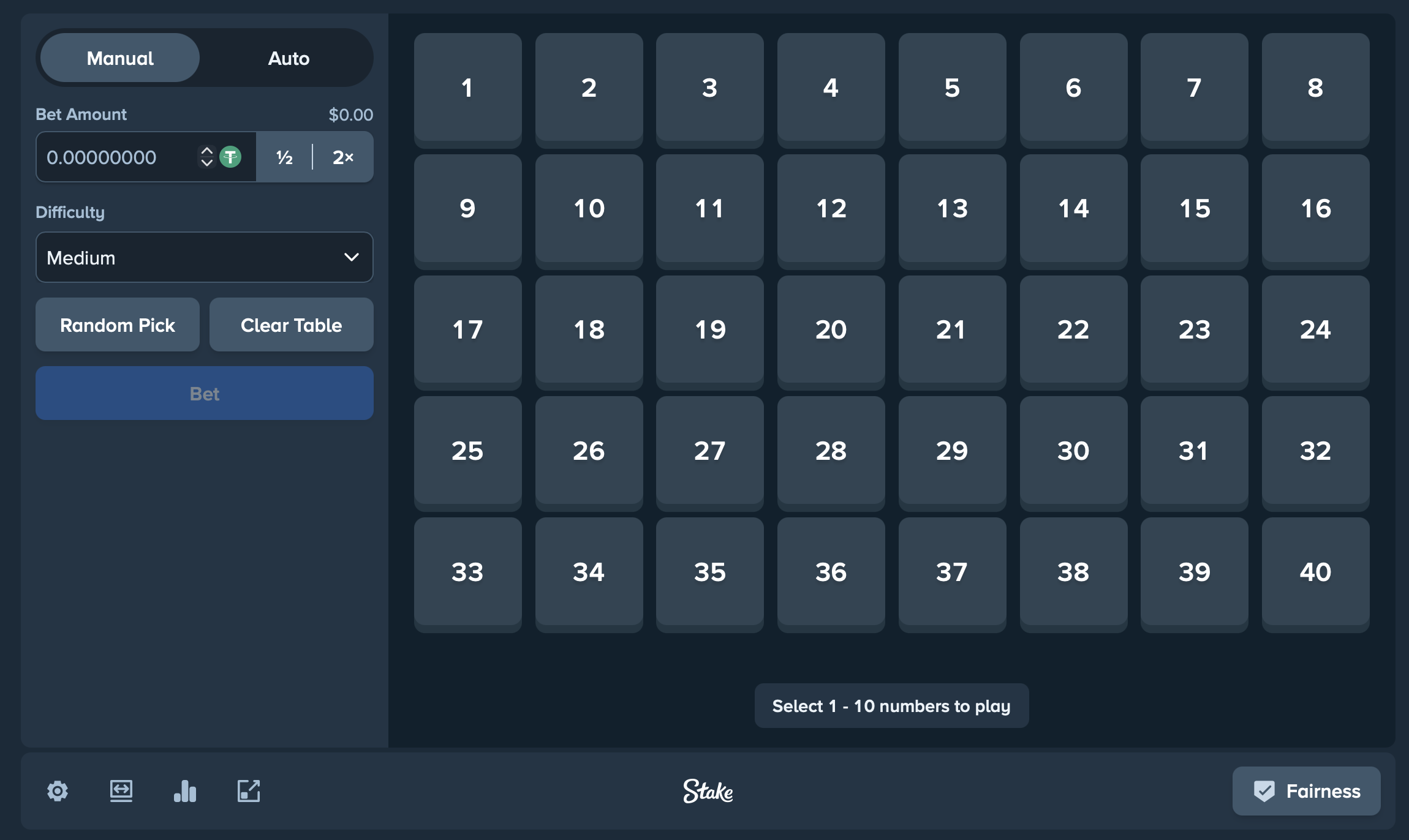
- Enter the amount for one round.
- Choose Classic, Low, Medium or High.
- Select one to ten numbers, or use Random Pick.
- Place the bet. Ten numbers are drawn from the board.
- Compare your matches with the payout row for your ticket.
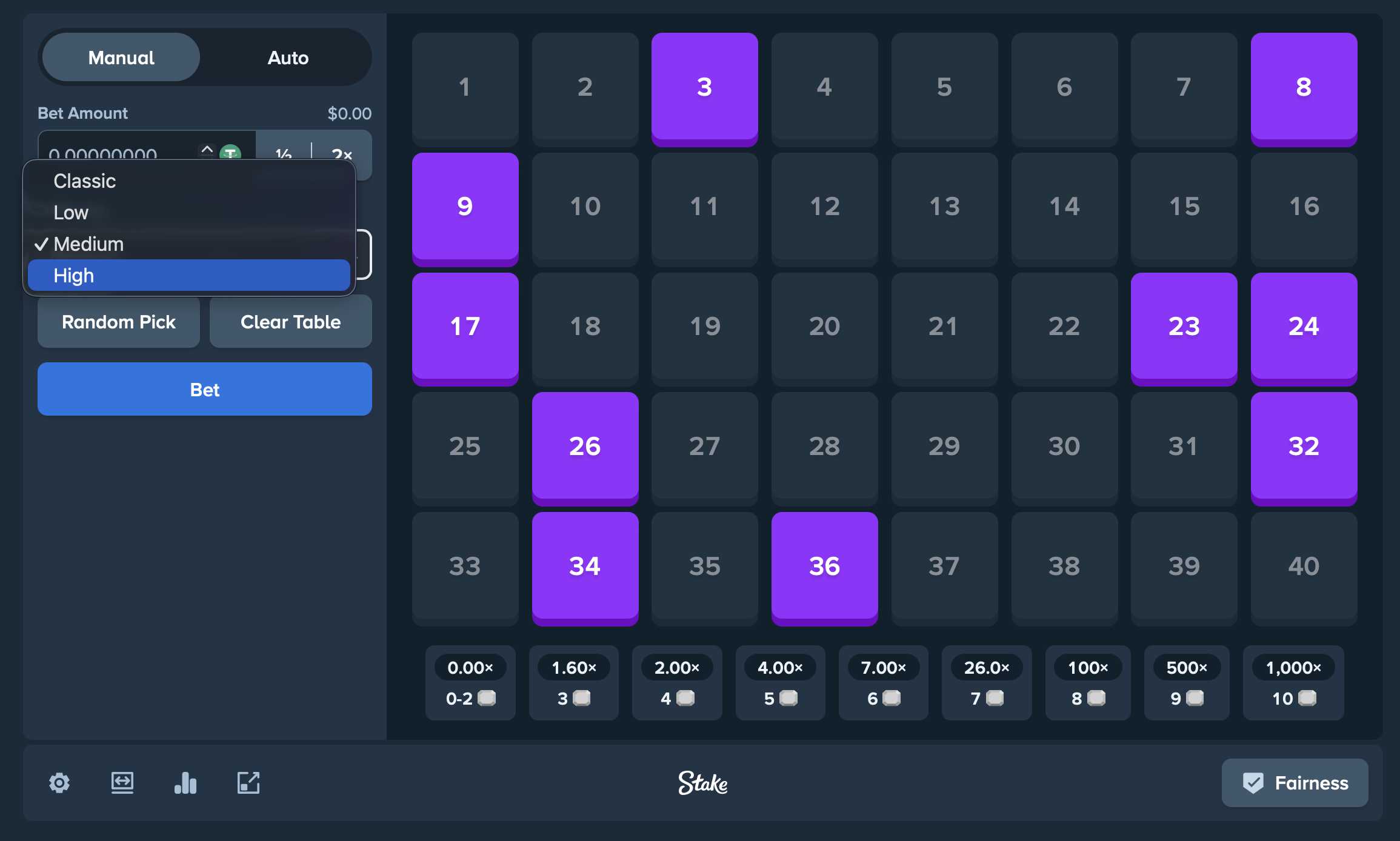
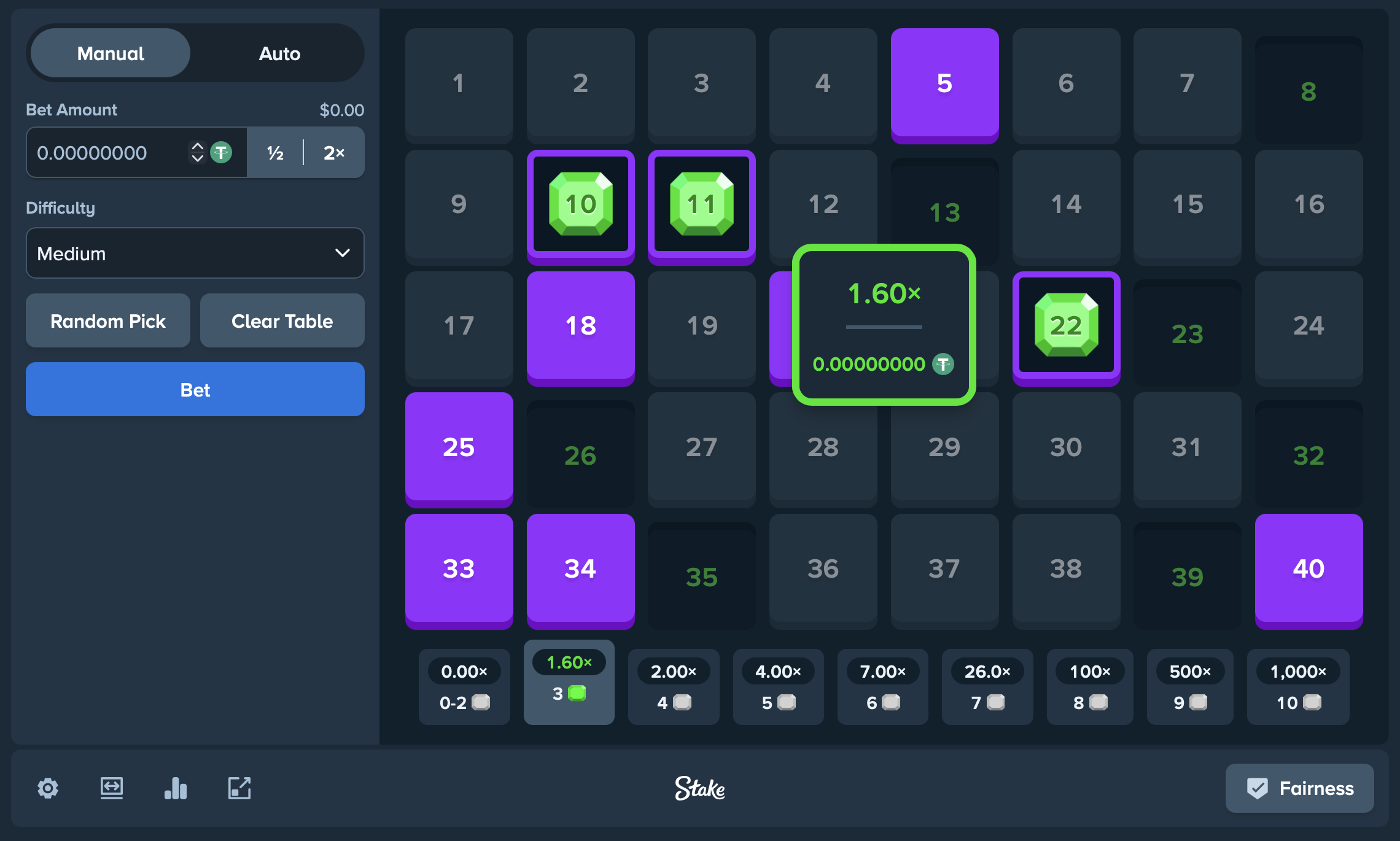
Picking ten numbers does not mean you need all ten to match before anything pays. For example, a ten-number ticket in Medium returns 1.60× for exactly three matches. In High, that same result returns nothing.
What the four risk levels change
Difficulty changes the payouts, not the draw. With the same number of picks, the probability of each match count is the same in every mode.
Classic, Low, Medium and High are useful labels, but compare the actual row for your ticket rather than assuming a label tells the whole story. Some Low tickets return part of the stake even when none of your numbers match. High concentrates more of its return into less frequent results.
A return below 1× is still a net loss. On a one-number Low ticket, a miss returns 0.70×: a $1 bet would return $0.70, leaving a $0.30 loss. A 1× return breaks even, and a return above 1× produces a profit before any other costs.
Stake Keno payout table: ten numbers selected
The table below covers every possible match count for a ten-number ticket. These are total-return multipliers, including the stake. A 2× result on a $1 bet returns $2 in total, for a $1 net profit.
| Matches | Classic | Low | Medium | High |
|---|---|---|---|---|
| 0 | 0× | 0× | 0× | 0× |
| 1 | 0× | 0× | 0× | 0× |
| 2 | 0× | 1.10× | 0× | 0× |
| 3 | 1.40× | 1.20× | 1.60× | 0× |
| 4 | 2.25× | 1.30× | 2× | 3.50× |
| 5 | 4.50× | 1.80× | 4× | 8× |
| 6 | 8× | 3.50× | 7× | 13× |
| 7 | 17× | 13× | 26× | 63× |
| 8 | 50× | 50× | 100× | 500× |
| 9 | 80× | 250× | 500× | 800× |
| 10 | 100× | 1,000× | 1,000× | 1,000× |
Source: interface screenshots and Stake's published Keno description, checked on 23 October 2026. This is a ten-pick comparison, not a table for every ticket size. Check the in-game row before betting.
The trade-off is clear at eight matches: High returns 500×, compared with Classic's 50×. But High pays nothing for three matches, where Classic returns 1.40× and Medium returns 1.60×.
What are the odds of winning?
First decide what you mean by winning: matching a number, getting any money back, making a net profit, or reaching the maximum multiplier. Those are different events.
Any individual number has a 10-in-40 chance of appearing: 25%. Numbers are drawn without replacement, so matching several chosen numbers is not calculated by multiplying 25% by itself.
| Ticket | Exact event | Probability |
|---|---|---|
| 1 number | Your number is drawn | 25% — 1 in 4 |
| 2 numbers | Both are drawn | About 5.77% — 1 in 17.33 |
| 10 numbers | Exactly 8 match | About 0.002309% — 1 in 43,303 |
| 10 numbers | All 10 match | About 0.000000118% — 1 in 847,660,528 |
For a ten-number ticket, Low returns more than the stake on about 79.58% of rounds. Classic and Medium do so on about 48.51%; High on about 19.69%. These figures are calculated from the complete ten-pick table above. They do not apply to other ticket sizes, and a higher payout frequency does not mean a better expected return.
The ten-for-ten figure is the chance of that specific result. It is not a universal probability for every 1,000× outcome across every ticket size.
For readers who want the calculation, the probability of exactly k matches from n picks is:
P(K = k) = C(n, k) × C(40 − n, 10 − k) / C(40, 10)
Here, C(a, b) counts combinations. This model assumes a uniform draw of ten distinct numbers from forty. It calculates theoretical odds, not results observed in a short session.
What does Stake Keno's 99% RTP mean?
Stake lists 99% RTP, equivalent to a 1% advertised house edge. RTP is a mathematical expectation across wagers, not a promise about your next session.
The one-number Classic ticket makes this easy to see. A match has a 25% probability and returns 3.96×. A miss returns zero:
0.25 × 3.96 + 0.75 × 0 = 0.99
The expected total return is $0.99 per $1 wagered. On an individual $1 round, however, this ticket returns either $3.96 or nothing.
The advertised 99% is a headline figure. Calculating from the displayed multipliers does not give exactly 99% for every ticket. For example, one-number Low gives 0.75 × 0.70 + 0.25 × 1.85 = 0.9875, or 98.75%. The published values do not establish why the returns differ from the advertised figure.
Neither a long losing streak nor a recent payout makes the next round owe you a win.
Auto Play and the October 2026 update
The Auto tab lets you place repeated bets instead of starting each round manually. Check the wager amount and the controls available in your current version before starting.
The company announcement published by iGaming Business on 22 October describes an interface and control refresh. Stake's weekly recap on 23 October also describes the changes and says the odds and payouts stayed the same.
The reported changes include a dropdown for choosing one to ten random picks, dragging across tiles to select or clear several numbers, saved selections and difficulty, and a smaller payout display with easier mobile tooltips. Winning tiles also received a new gem animation.
The 22 October announcement reports Auto Play as 33% faster and Instant Play as 15% faster. These are announcement figures, not timings measured for this review. They should not be read as improvements to RTP or the chance of a match.
Faster betting can also use a session budget faster. Set the wager amount and any available stop conditions before starting Auto Play.
How Provably Fair verification works
Stake's verification system lets you check a completed result against its published generation method. It uses a client seed, a server seed and a round nonce. The server seed is initially represented by a hash; after the relevant seed is revealed, the result can be checked.
Keep the round details and use Stake's published verification instructions. A screenshot of the dialog alone does not verify an individual round.
Provably Fair verification checks the result-generation process. The payout table still includes a house edge.
Is there a Stake Keno strategy that improves the odds?
As with Stake Plinko, lucky numbers, grid patterns and switching difficulty after losses do not change the probability of the next draw. Random Pick and manual selection have the same theoretical odds for the same ticket size.
What you can change is the amount at risk, the payout distribution and how many rounds you play. Raising the wager after a loss raises the amount you can lose; it does not improve the draw probabilities.
Where is Stake Keno available?
Stake.com availability depends on your current jurisdiction, the operator's rules and account eligibility. Use this page's location selector for the site's regional availability information, then check the operator's current terms. The selector is a guide, not a guarantee that an account can play.
Stake Keno FAQ
What is the maximum payout?
Stake advertises a maximum multiplier of 1,000×. It is available only on certain tickets and results. A maximum multiplier is different from the maximum cash payout, which can also be subject to betting and payout limits.
Does High risk improve the chance of matching numbers?
No. For the same ticket size, each match count has the same probability in all four modes. High changes what those matches pay.
Can a result return money and still lose?
Yes. Any multiplier below 1× returns less than the stake. For example, 0.70× returns $0.70 from a $1 wager.
Did the October update change the RTP?
The update announcements say the odds and payouts were unchanged. The refresh concerns the interface and betting controls.
Is Stake.com Keno the same as Stake.us Keno?
This article covers Stake.com. Do not transfer its account rules, availability or payout information to another platform without checking that platform's own game information.
What to check before playing
Changing the risk level changes the payout for a result, not your ability to predict it.
Read the payout row for your exact number of picks. Compare frequent small returns with rarer larger ones, and treat 99% RTP as an advertised long-run figure rather than a session target.
Source: Stake Keno update — company announcement published by iGaming Business, October 22, 2026.